
Music as a Trance State

Music as a Trance State

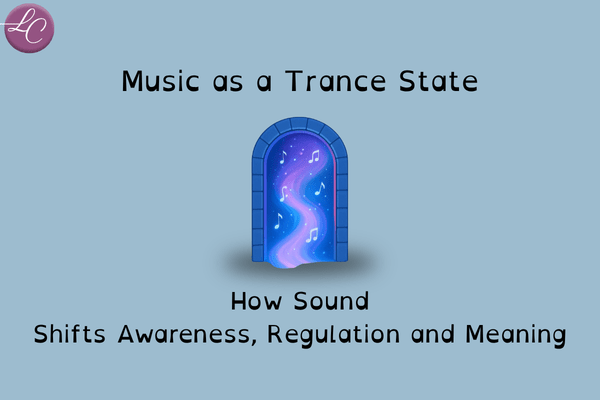
Music as a Trance State: How Sound Shifts Awareness, Regulation and Meaning

Music as a trance state is not something we talk about very often, yet many people have experienced it.

A song begins. The world around us softens. Time seems to loosen its grip. For a few moments, or perhaps much longer, we are somewhere else entirely.

Not lost.

Not disconnected.

If anything, we may feel more connected than usual.

For many neurodivergent people, music is far more than entertainment. It can become a doorway into regulation, reflection, creativity, memory, identity, and meaning. Certain songs seem to alter the texture of awareness itself, creating a space where thoughts settle, emotions become clearer, and the nervous system finds room to breathe.

What Does Music as a Trance State Feel Like?

When people hear the word “trance”, they often imagine something dramatic or mystical.

In reality, trance-like experiences are surprisingly common.

Have you ever:

  • Become completely absorbed in a piece of music?
  • Lost track of time while listening?
  • Felt transported to another place or emotional landscape?
  • Noticed that the outside world seemed quieter or less demanding?
  • Experienced a sense of deep focus or calm that felt different from everyday attention?

These experiences exist on a spectrum. They do not necessarily involve losing awareness. Instead, they often involve shifting awareness.

The spotlight of attention narrows. Certain sensations become more vivid. Internal experiences may feel richer, clearer, or more meaningful.

For neurodivergent people, whose sensory and attentional experiences may already differ from the norm, music can become a particularly powerful vehicle for these shifts.

Music as a Trance State and Nervous System Regulation

One reason music can feel so transformative is that it interacts directly with the nervous system.

Rhythm, repetition, harmony, texture, and familiarity all influence how safe or activated we feel.

When we encounter sounds that resonate with our needs in a given moment, the nervous system may begin to settle.

Sometimes this looks like relaxation.

It can look like emotional release.

Sometimes it looks like finally being able to think clearly after a day of sensory overwhelm.

The process is rarely about forcing calm. Instead, music often creates conditions that allow the body and mind to move naturally toward regulation.

Many neurodivergent adults describe using music to:

  • Transition between activities
  • Recover from sensory overload
  • Process difficult emotions
  • Support concentration
  • Reduce mental clutter
  • Create a sense of predictability
  • Maintain emotional balance

The music itself becomes a kind of companion, helping to shape the internal environment.

When Music Becomes a Place

Some songs do more than regulate us.

They become places.

A familiar piece of music can feel like stepping into a landscape that exists outside ordinary time. Certain songs carry emotional textures, images, memories, and meanings that remain remarkably stable across years or even decades.

Returning to them can feel less like remembering and more like revisiting.

This experience is particularly interesting because it is not always driven by nostalgia.

Sometimes the song is not connected to a specific memory at all.

Instead, it evokes a feeling, a perspective, or a state of being that remains personally significant.

The music becomes a container for something difficult to describe in words.

Identity, Continuity and Meaning-Making

Many neurodivergent people spend years adapting to environments that may not fully understand how they experience the world.

Over time, music can become one of the threads that helps maintain a sense of continuity.

A song that resonated deeply at fifteen may still resonate at forty-five.

The circumstances may have changed.

The person may have changed.

Yet something essential remains recognisable.

Music can remind us of:

  • Who we have been
  • Who we are becoming
  • What matters to us
  • How we make sense of the world
  • What helps us feel most alive

In this way, music is not merely background sound.

It becomes part of an ongoing conversation with ourselves.

The Value of Deep Listening

Modern life often rewards speed, productivity, and constant stimulation.

Deep listening offers something different.

It invites us to slow down long enough to notice what is happening internally.

Rather than using music purely as background noise, we can allow ourselves to become fully immersed in the experience.

There is no requirement to analyse it.

No need to justify it.

No expectation that it should be useful.

Sometimes the value lies simply in being present with the sounds, emotions, images, and sensations that emerge.

In a world that frequently asks us to move faster, deep listening can become a quiet act of self-understanding.

Music as a Trance State Is Deeply Personal

The songs that create these experiences differ from person to person.

For one individual, it may be an orchestral piece.

For another, it may be post-punk, ambient music, folk, metal, electronic music, or a favourite film score.

There is no universal playlist.

What matters is the relationship between the listener and the sound.

The most powerful music is often the music that speaks to something uniquely personal, offering a pathway into regulation, reflection, meaning, or wonder.

Continue Exploring

If you’ve ever felt that the usual explanations for being human don’t quite fit, you may enjoy my free guide When the Rule Book Doesn’t Fit.

It explores neurodivergent identity, self-understanding, and finding language for experiences that often sit outside conventional narratives.

You can also explore more reflections through The Outsider Within, where music, identity, belonging, and lived experience intersect.

Neurodivergent Identity and Emotional Recognition Through Music

Neurodivergent Identity and Emotional Recognition Through Music

When Neurodivergent Identity and Emotional Recognition Comes Through Music

Sometimes understanding does not begin with explanation.

It begins with recognition.

A feeling lands before words fully form.
Something inside quietly responds before the mind catches up.
A song suddenly feels less like music and more like a mirror.

For many neurodivergent adults, emotional recognition arrives long before there is language for it.

Music can become one of the first places where identity feels visible.

Feeling different before there were words for it

Many neurodivergent people grow up carrying a persistent sense of difference without fully understanding why.

This can look like:

  • feeling slightly outside social spaces
  • adapting constantly to fit in
  • masking confusion or intensity
  • internalising misunderstanding as personal failure

Without a framework for neurodivergence, those experiences are often interpreted through self-blame rather than self-understanding.

Music as emotional recognition

Music has a unique way of bypassing analysis and speaking directly to lived experience.

Certain songs do more than entertain.

They recognise.

A lyric, tone, rhythm, or emotional texture can suddenly illuminate something that has been present internally for years.

This is why neurodivergent identity emotional recognition music can feel so powerful.

Music can:

  • create emotional clarity
  • reflect internal experience
  • validate feelings that previously felt isolated
  • reconnect people to parts of themselves hidden beneath masking

Sometimes recognition through music arrives before diagnosis, language, or conscious understanding.

Alienation and the grief of misunderstanding

Feeling “different” over long periods of time can shape identity deeply.

Not through one major moment, but through accumulation:

  • repeated misunderstanding
  • social exhaustion
  • adapting to avoid rejection
  • wondering why things feel harder than they seem for others

When recognition finally arrives, grief can emerge alongside relief.

There may be grief for:

  • years spent masking
  • emotional isolation
  • unmet support needs
  • versions of self shaped around survival rather than understanding

Reclaiming identity through recognition

Recognition changes the internal story.

Instead of: “What is wrong with me?”

A different possibility begins to emerge: There may have been a reason things felt this hard.

That shift matters profoundly.

Because understanding neurodivergent identity through emotional recognition creates space for self-compassion instead of self-erasure.

Latest Video – Alienation, Grief & Reclaiming Difference

Watch it here.

This Song Transports My AuDHD Brain

This Song Transports My AuDHD Brain

This Song Transports My AuDHD Brain

A Forest and the Inner Worlds We Live In

This song transports my AuDHD brain — but not in a way that feels like leaving.

It feels like entering.

Some songs don’t stay at the surface.
They open something.

A doorway.
A landscape.
A place that feels both unfamiliar… and deeply known.

The Forest Isn’t Just a Song

When I listen to A Forest by The Cure, I’m no longer just hearing music.

There’s space.
Distance.
Movement.

The bass feels like footsteps.
The air feels dim, expansive.
There’s a sense of searching — but without urgency.

And in that space, something in me softens.

Not because I’ve “escaped” anything.

But because I’ve found a different way of being with it.

The Inner Worlds We Don’t Always Talk About

For much of my life, I’ve had a strong pull toward what I can only describe as other worlds.

Not fantasy in a performative sense.
Not something to explain or justify.

Just… a quiet, ongoing curiosity.

What would it feel like to be there?
To see differently?
To move through something unfamiliar?

This might look like:

  • Getting lost in music
  • Re-reading the same books
  • Watching films that create a certain feeling
  • Staring at the sky and following shapes through clouds
  • Imagining something just beyond what’s visible

For a long time, I didn’t have language for this.

Now, I understand it as part of how I experience the world.

Not Escaping — Expanding

It’s easy to label this as escapism.

But that never quite fit.

Because I wasn’t trying to leave my life.

I was:

  • Expanding it
  • Exploring it
  • Giving my mind somewhere to move freely

For an AuDHD brain — often active, layered, and constantly processing — these inner spaces can be deeply regulating.

They don’t demand.
Nor do they rush.
And, they don’t require resolution.

They simply hold.

The Quiet Intelligence of “Elsewhere”

There’s something quietly intelligent about being drawn to these spaces.

They can:

  • Offer rest without shutdown
  • Allow emotion without overwhelm
  • Create meaning without needing to define it

And sometimes, they let us feel something we didn’t yet know how to name.

What Are Your “Other Worlds”?

This is something I’m becoming more curious about — not just for myself, but for others.

Not as something to analyse.

But something to notice.

You might like to gently explore:

  • What do you find yourself returning to again and again?
  • Is there a song, film, or text that creates a particular space for you?
  • Are there moments where you naturally drift — into imagination, memory, or sensation?
  • What environments feel quietly expansive (nature, water, sky, music)?
  • Do you ever find yourself imagining beyond what’s physically present?

And perhaps most simply:

  • Where do you go… when you’re not trying to go anywhere?

Letting It Be Valid

These inner experiences don’t always need to be explained.

They don’t need to be productive.
Or shared.
Or even fully understood.

But they can be:

Because they may be doing more for you than you realise.

A Doorway, Not a Destination

For me, A Forest is one of those doorways.

Not somewhere I stay.

But somewhere I pass through — and come back a little quieter, a little clearer.

If you’re curious, I’ve shared more about this experience here:

A final thought

Not everything that looks like “elsewhere” is avoidance.

Sometimes, it’s where we find:

  • Space
  • Regulation, and
  • A deeper understanding of ourselves

Even if we never quite put it into words.

You May Be Interested

If this reflection resonated, you might also like:

Each of these explores a different facet of the same experience — how neurodivergent minds move, rest, and make meaning.