That’s not mine!
Have you ever had a comment, judgement or expectation stick to you long after the person who said it has forgotten it?
That’s not mine.
Sometimes those three words can be surprisingly powerful.
We move through the world surrounded by other people’s perceptions, expectations, assumptions and stories. Some land lightly and disappear. Others catch somewhere tender and seem to stay attached.
A criticism can become a self-doubt.
A passing comment can become an internal rule.
Someone else’s expectation can quietly turn into something we feel responsible for.
Yet being affected by something does not automatically mean it belongs to us.
When something sticks
I keep coming back to the image of sticky notes.
Imagine moving through life with little notes occasionally being placed on you:
Too sensitive.
Difficult.
Selfish.
You should…
You need to…
You’re responsible for…
They think you’re…
Some might be completely irrelevant.
Others might contain a useful piece of information, at least for a particular moment.
A few might once have been relevant but no longer fit the person you have become.
And occasionally, one might actually contain something worth considering.
The important part is that we don’t have to accept every note simply because it’s stuck there.
Being affected isn’t the same as belonging
This distinction matters.
Some things can hurt without being true.
Other things can matter without becoming part of your identity.
Something can change the way you see yourself for a while without having to remain there permanently.
In other words:
This affected me is not the same as this belongs to me.
That difference can be particularly important when criticism or rejection touches an existing vulnerability.
A comment may land with enormous force. You might replay it, analyse it, remember exactly where you were when you heard it, or find yourself anticipating the same judgement again.
The intensity of the reaction can make the message feel important.
But intensity isn’t proof.
Sometimes what sticks tells us something about the place it landed rather than the truth of what was said.
We don’t have to untangle the whole web
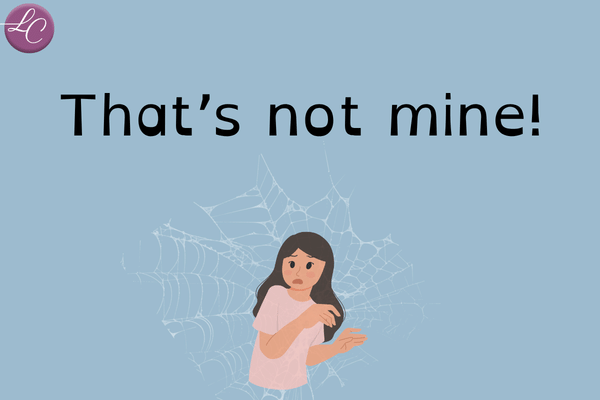
This is where I think the image of a spiderweb becomes interesting.
A web can catch you without you deliberately choosing to enter it.
Perhaps someone else’s expectations have become tangled around you. Maybe there is blame, obligation, judgement or an assumption about who you are.
It can be tempting to start pulling at every strand.
- Why did they say that?
- What did they mean?
- Was there something I did?
- How did this become my responsibility?
- How do I make them understand?
Sometimes that exploration is useful.
Sometimes it simply creates a larger tangle.
There may be another question that is more useful:
Is this actually mine?
Not Who is to blame?
Not How do I fix the whole situation?
Just:
Does this belong with me?
Discernment gives us a choice
Discernment isn’t about rejecting everything uncomfortable.
Nor is it about deciding that every criticism is someone else’s problem.
It is the quieter practice of noticing.
- Is there something here I need to learn?
- Does this still fit?
- Was this ever mine?
- Am I carrying responsibility that belongs somewhere else?
- Do I want to keep this?
That last question matters.
Because even when something genuinely belongs to us, we can decide what we want to do with it.
A sticky note can contain information without becoming an identity.
A mistake can teach us something without becoming a definition.
Relationships can matter without making us responsible for another person’s feelings.
A painful experience can remain part of our history without being required to become our future.
What gets to stay attached?
Perhaps the invitation isn’t to become completely untouched by other people.
That would be impossible.
We are relational creatures; we notice one another; we influence one another; we care; we absorb things; we respond.
The invitation might instead be to become a little more discerning about what we carry.
- Something sticks.
- We notice it.
- Pause.
- We ask whether it is ours.
- Then we get to choose.
Sometimes the answer will be yes.
Sometimes it will be not anymore.
And sometimes, perhaps, it will simply be:
That’s not mine!
And we can let it go.
Check out The Outsider Within: The Songs Playlist here.