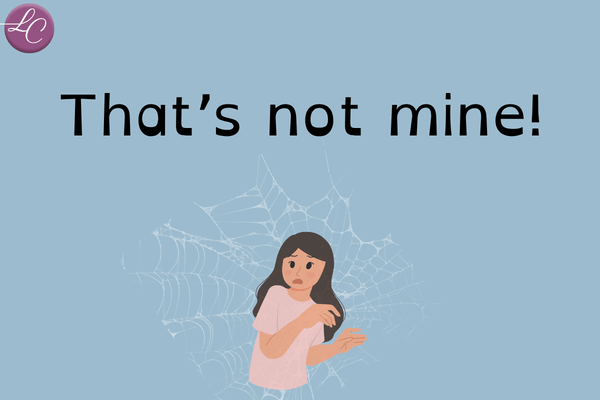
That’s not mine!

That’s not mine!

That’s not mine!

Have you ever had a comment, judgement or expectation stick to you long after the person who said it has forgotten it?

That’s not mine.

Sometimes those three words can be surprisingly powerful.

We move through the world surrounded by other people’s perceptions, expectations, assumptions and stories. Some land lightly and disappear. Others catch somewhere tender and seem to stay attached.

A criticism can become a self-doubt.

A passing comment can become an internal rule.

Someone else’s expectation can quietly turn into something we feel responsible for.

Yet being affected by something does not automatically mean it belongs to us.

When something sticks

I keep coming back to the image of sticky notes.

Imagine moving through life with little notes occasionally being placed on you:

Too sensitive.

Difficult.

Selfish.

You should…

You need to…

You’re responsible for…

They think you’re…

Some might be completely irrelevant.

Others might contain a useful piece of information, at least for a particular moment.

A few might once have been relevant but no longer fit the person you have become.

And occasionally, one might actually contain something worth considering.

The important part is that we don’t have to accept every note simply because it’s stuck there.

Being affected isn’t the same as belonging

This distinction matters.

Some things can hurt without being true.

Other things can matter without becoming part of your identity.

Something can change the way you see yourself for a while without having to remain there permanently.

In other words:

This affected me is not the same as this belongs to me.

That difference can be particularly important when criticism or rejection touches an existing vulnerability.

A comment may land with enormous force. You might replay it, analyse it, remember exactly where you were when you heard it, or find yourself anticipating the same judgement again.

The intensity of the reaction can make the message feel important.

But intensity isn’t proof.

Sometimes what sticks tells us something about the place it landed rather than the truth of what was said.

We don’t have to untangle the whole web

This is where I think the image of a spiderweb becomes interesting.

A web can catch you without you deliberately choosing to enter it.

Perhaps someone else’s expectations have become tangled around you. Maybe there is blame, obligation, judgement or an assumption about who you are.

It can be tempting to start pulling at every strand.

  • Why did they say that?
  • What did they mean?
  • Was there something I did?
  • How did this become my responsibility?
  • How do I make them understand?

Sometimes that exploration is useful.

Sometimes it simply creates a larger tangle.

There may be another question that is more useful:

Is this actually mine?

Not Who is to blame?

Not How do I fix the whole situation?

Just:

Does this belong with me?

Discernment gives us a choice

Discernment isn’t about rejecting everything uncomfortable.

Nor is it about deciding that every criticism is someone else’s problem.

It is the quieter practice of noticing.

  • Is there something here I need to learn?
  • Does this still fit?
  • Was this ever mine?
  • Am I carrying responsibility that belongs somewhere else?
  • Do I want to keep this?

That last question matters.

Because even when something genuinely belongs to us, we can decide what we want to do with it.

A sticky note can contain information without becoming an identity.

A mistake can teach us something without becoming a definition.

Relationships can matter without making us responsible for another person’s feelings.

A painful experience can remain part of our history without being required to become our future.

What gets to stay attached?

Perhaps the invitation isn’t to become completely untouched by other people.

That would be impossible.

We are relational creatures; we notice one another; we influence one another; we care; we absorb things; we respond.

The invitation might instead be to become a little more discerning about what we carry.

  1. Something sticks.
  2. We notice it.
  3. Pause.
  4. We ask whether it is ours.
  5. Then we get to choose.

Sometimes the answer will be yes.

Sometimes it will be not anymore.

And sometimes, perhaps, it will simply be:

That’s not mine!

And we can let it go.

Yellow Ladybugs Conference 2025

Yellow Ladybugs Conference 2025

Yellow Ladybugs Conference 2025

I recently had the privilege of attending the Yellow Ladybugs Conference 2025 — a space dedicated to supporting autistic girls and gender-diverse young people. It was an inspiring, heart-opening experience filled with wisdom that I’m eager to share with you. Here are some of the most powerful insights that stayed with me:

Reflections and Insights 

Neurokin: The Power of Connection Among Neurodivergent People

One beautiful concept I encountered is neurokin — yes, that word really exists!

It describes the unique connection and understanding that naturally forms between neurodivergent individuals. It’s that unspoken bond, a deep sense of being seen and understood without explanation.

Neurokin reminds us that community isn’t just nice to have — it’s vital for our wellbeing and growth.

When Escalation Happens, Step Away

A key practical reminder was about emotional escalation.

Sometimes, especially within families or close communities where neurodivergence is common, tensions can rise quickly, with everyone amplifying each other’s stress.

The advice was simple but powerful: if you find yourself escalating with someone else, it’s a clear sign to step away — physically or emotionally — to reset before reconnecting.

This pause can prevent misunderstandings and create space for compassion.

Conflicting Needs Within Neurodivergent Families

Many neurodivergent traits are shared within families, which means conflicting needs are natural and expected.

Sometimes, two or more people want different things at the same time — sensory comfort, quiet, movement, or social interaction.

The takeaway? Express your needs clearly, listen to others, and sometimes prioritise whose needs take precedence in the moment.

It’s not always easy, but communication and mutual respect help everyone feel seen and supported.

Rejection Sensitive Dysphoria (RSD): A Lifeline for Understanding

I had never heard of Rejection Sensitive Dysphoria (RSD) before this conference.

Learning about RSD was deeply helpful in understanding why so many neurodivergent people can find themselves in dysfunctional or painful relationships.

RSD involves intense emotional pain triggered by perceived (or real) rejection or criticism — often disproportionate to the event itself.

Knowing about RSD can be a lifeline: it’s not “just being too sensitive,” but a neurological response that deserves compassion and tailored strategies.

PDA Is So Much More Than “Not Wanting to Be Told What to Do”

Pathological Demand Avoidance (PDA) came up frequently.

The common misconception is that PDA means simply “not wanting to be told what to do.”

But in reality, PDA is a complex profile that affects everyday life deeply. It involves anxiety-driven avoidance of demands, sometimes leading to creative resistance, social strategies, or emotional shutdowns.

Understanding PDA means seeing beyond behaviour to the underlying emotions and needs — which opens pathways for more supportive responses.

The Power of Lived Experience: Nothing About Us Without Us

A thread throughout the Yellow Ladybugs Conference 2025 was the importance of lived experience. 

When it comes to understanding and supporting neurodivergent people, nothing replaces the insight of those who have walked the path themselves.

Whether it’s through research, education, therapy, or everyday advocacy, the voices of neurodivergent people must be central. Lived experience brings nuance, authenticity, and clarity that no second-hand interpretation can match.

When we centre neurodivergent voices, we move closer to support that actually fits — support that respects autonomy, celebrates difference, and meets real needs with compassion.

As they often said: “Nothing about us without us.”

Energy Meter: A Brilliant Tool for Managing Your Day

One of the most practical tools shared was the Energy Meter from Autism Level Up. This tool invites you to gauge your current energy levels and consider whether your energy matches the task at hand. For example, if you’re “amped up and fidgety,” is that the right energy state for working on a focused project?

If it’s not a match, do you need to level up or level down?

What’s especially important is that you — the individual — decide where you are at and choose the energy level required for your task. Everyone expresses energy levels differently.

As they say, “If you’ve met one Autistic person, you’ve met one Autistic person.” There’s no one-size-fits-all approach. Autism Level Up offers resources to help you learn how to adjust your energy intentionally to meet your needs.

Closing Words

Attending the Yellow Ladybugs Conference 2025 reminded me how important it is to stay curious and compassionate — especially with ourselves and those we love who navigate the world differently. It also reminded me how important community is – where there is an unspoken understanding and deep respect for one another. I am already looking forward to next year’s conference.

The insights I gained are gifts I’ll carry forward, and I hope sharing them can support you too.

If you’d like to hear more about any of these topics or want resources, please reach out or comment below. Let’s keep building that beautiful neurokin community together (you can come and join Different… and Loving It! if you like!).

With warmth and deep respect,
Lucinda