Neurodivergent Identity & The Layers We Carry

Neurodivergent Identity & The Layers We Carry

Neurodivergent Identity & The Layers We Carry

Stories Waiting to Be Told and Understood

Neurodivergent identity is not something we discover by peeling away everything that came before.

It is something we come to understand by becoming curious about the layers we carry.

The experiences.

Our adaptations.

The ways we learned to navigate the world.

The things we developed because we needed them, valued them, or simply because they became part of who we are.

When we talk about layers, it can be tempting to imagine that there is a “real self” hidden underneath everything else. A pure version waiting to be uncovered once all the protective layers are removed.

But perhaps identity is not found by taking things away.

Perhaps identity is discovered by listening to the stories held within what has already grown.

Neurodivergent Identity Is Built Through Experience

Many neurodivergent adults spend time looking backwards.

After diagnosis, self-discovery, or a significant moment of recognition, old experiences can begin to look different.

Behaviours that once seemed confusing may suddenly make sense.

A preference that felt unusual may reveal itself as a need.

Perhaps a lifelong pattern may become a clue rather than a flaw.

This process can involve grief, relief, curiosity, and compassion all at once.

Because understanding ourselves often means revisiting the layers that formed along the way.

Some layers were shaped by challenge.

Others were shaped by joy.

Some were created because they helped us belong.

Others were created because they helped us survive.

All of them are part of the story.

The Difference Between Layers and Masking

Masking is an important part of many neurodivergent experiences.

For some people, layers develop because they have learned to hide parts of themselves in environments where those parts were misunderstood, discouraged, or unsafe.

These layers may include:

  • Suppressing natural responses
  • Monitoring behaviour constantly
  • Copying expected social patterns
  • Hiding overwhelm
  • Minimising needs

Over time, these adaptations can become exhausting.

But not every layer is masking.

This distinction matters.

A layer can also be a:

  • Creative expression of identity
  • Skill developed through experience
  • Role that feels meaningful
  • Routine that supports wellbeing
  • Passion that has become part of who we are
  • Way of connecting with others

The question is not always: “What am I hiding?”

Sometimes the more helpful question is: “What purpose does this layer serve?”

The Stories Held Within Our Layers

The layers we carry are often stories waiting to be told and understood.

A preference for routine may hold a story about creating stability in a world that often feels unpredictable.

Your deep interest may hold a story about curiosity, connection, and joy.

A carefully developed communication style may hold a story about learning how to be understood.

Maybe a tendency to withdraw may hold a story about needing space to recover.

When we approach ourselves with curiosity rather than judgement, these layers become information.

They become invitations to understand.

Tree Rings: The Evidence of Becoming

Trees offer a beautiful way to think about identity.

Each ring records a season.

A period of growth, challenge or a response to the conditions around it.

The tree does not become more itself by losing its rings.

The rings are the evidence of the tree’s journey.

They are not imperfections or obstacles.

They are the record of becoming.

Our own layers can be understood in a similar way.

They tell the story of where we have been, what we have experienced, what we have adapted to, and what has mattered along the way.

The goal is not to erase the rings.

The goal is to understand the tree.

When Music Helps Us Hear Our Own Stories

Sometimes we do not recognise a layer until something reflects it back to us.

A conversation.

A memory.

A piece of writing.

Or a song.

Music has a unique ability to make invisible experiences feel visible.

A song can connect us with emotions we have not named.

It can reveal patterns we have repeated.

It can bring awareness to parts of ourselves that have quietly existed in the background.

The music does not create the story.

It helps us hear it.

Understanding Ourselves With Compassion

There is wisdom in becoming curious about the layers we carry.

Not every layer needs to stay.

Some may no longer fit.

Others may feel heavier than they once did.

Some may have served an important purpose during one season of life but are ready to be reconsidered.

But before we decide to change a layer, it helps to understand why it formed.

Because every layer came from somewhere.

Every layer carries information.

Every layer belongs to the story of becoming.

What Are We Protecting? | Onion Skin – Boom Crash Opera

The latest The Outsider Within Video is the inspiration for this post – as I explored this song, I pondered even more deeply about the role which the layers/rings serve.

I’d love you to check it out – you can watch it here… and if you feel inclined, please subscribe to my channel.

Continue Exploring

If you have ever felt that the usual explanations for yourself do not quite fit, When the Rule Book Doesn’t Fit explores neurodivergent identity, self-understanding, and finding language for experiences that have often gone unnamed.

Creative Parenting for Neurodivergent Children – Part 2

Creative Parenting for Neurodivergent Children – Part 2

Creative Parenting for Neurodivergent Children

The Nurturing Practices That Shape a Life

When people talk about parenting, they often focus on outcomes.

Resilience.
Independence.
Confidence.

What rarely gets talked about is the felt sense a child carries into adulthood — the quiet, embodied knowing of whether they were safe to exist as themselves.

When I reflect on creative parenting for neurodivergent children, I don’t first think about strategies.

I think about atmosphere.

The nurturing practices my Mum offered weren’t grand or performative. They lived in the ordinary spaces: bedtime, play, food, conversation. And yet, they shaped everything.

Because what she gave us was not performance.

It was safety.

Stories as Regulation

Some nights, Mum read to us.
Some nights, she couldn’t.

She was a single parent, exhausted long before exhaustion had language. But even when she didn’t have the energy to read, she lay beside us and told stories instead. Familiar ones. Tweaked ones. Magical ones that felt half-alive in the dark.

Looking back as a neurodivergent adult, I see what those stories really were.

They were regulation.

Softening the edges of the day.
Creating continuity.
Offering predictability wrapped in imagination.

For neurodivergent children, stories can act as a bridge — between stimulation and rest, between chaos and coherence.

When I think about creative parenting for neurodivergent children, I think about that bridge.

Play as a World-Building Tool

We grew up with very little money, but we never felt deprived.

A cardboard box became a stagecoach.
A footstool became a driver’s seat.
Hobby horses carried us into entire worlds.

What mattered wasn’t the object. It was the permission.

Permission to —

  • Imagine fully
  • Immerse
  • Take play seriously.

As an adult, I understand something I couldn’t name then:

Imagination is not escapism for neurodivergent children.

Imagination is processing.
Integration.
It is nervous system recalibration through story and movement.

Creative parenting for neurodivergent children honours this instead of dismissing it.

Meeting Sensory Needs with Creativity

Food was complicated.

Textures lingered.
Smells overwhelmed.
Certain after-feels stayed far too long.

Instead of forcing compliance, Mum invited curiosity.

Enter: Spiderman’s favourite foods.

One day a letter arrived. A list was revealed. Suddenly, the question shifted from
“Why won’t you eat this?”
to
“What would Spiderman choose?”

Play replaced pressure.
Identity replaced shame.

When a neurodivergent child feels respected instead of corrected, the nervous system loosens its grip.

That shift is not small.

It is foundational.

Trust as the Ultimate Gift

As we grew older, Mum didn’t tighten control.

She loosened it.

Decisions were talked through. Risks were named. But the final choice was ours. And when things didn’t work out, she didn’t weaponise hindsight.

She stayed.

As a neurodivergent adult reflecting back, this might be the practice that shaped me most.

Trust teaches responsibility without fear.
Autonomy without abandonment.
Exploration without exile.

Creative parenting for neurodivergent children is not about removing structure.

It is about embedding structure inside relationship.

Video: Creative Parenting for Neurodivergent Children – Part 2

In Part 2 of this series, I explore these themes more deeply — and what happens when traditional parenting frameworks simply do not fit the nervous system of the child in front of you.

A Closing Reflection

What stays with me is not any single strategy.

It is the orientation underneath it all.

We were —

  • Seen
  • Trusted
  • Allowed to become.

As an adult, that early sense of safety still lives in my nervous system.

Creative parenting for neurodivergent children does not guarantee ease.

But it does shape identity.

It shapes whether a child grows up believing they are a problem to be solved —
or a person to be understood.

That difference lasts a lifetime.

When the Rule Book Doesn’t Fit

For many neurodivergent adults, there comes a moment of reckoning:

You realise the rule book you were handed was never written with you in mind.

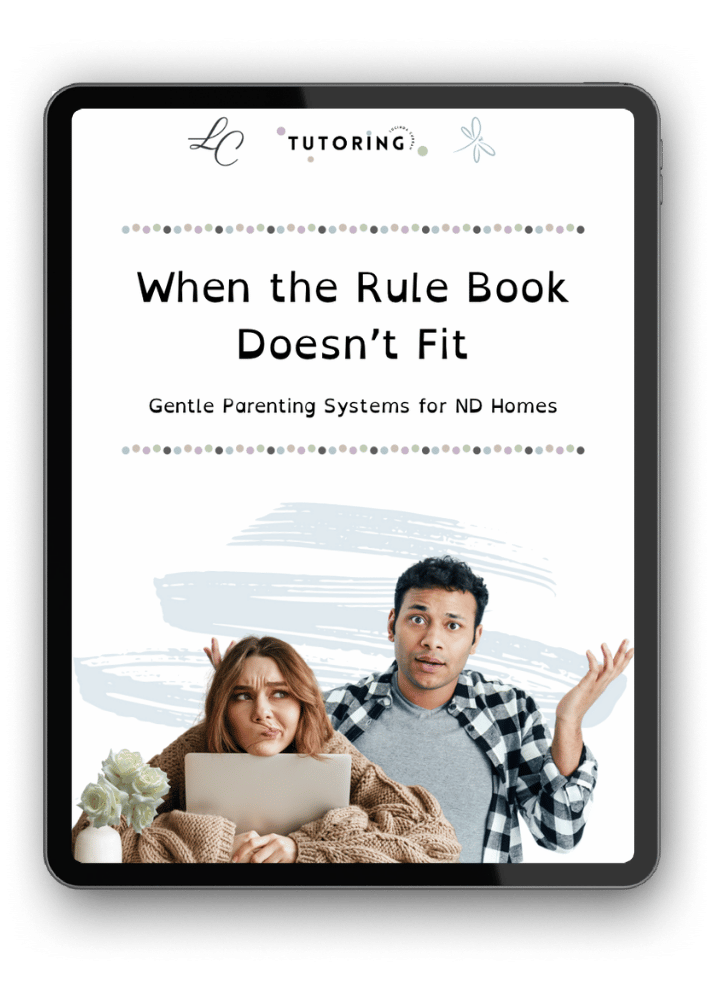
If this reflection resonates, I’ve created something inspired by this very truth – When the Rule Book Doesn’t Fit

It’s for neurodivergent adults and reflective parents who are ready to question inherited templates and create regulation-informed ways of living instead.

Get Your FREE Copy Here

You Might Also Be Interested In

Creative Parenting for Neurospicy Kids: The Clever Systems My Mum Used (Part 1)
A reflection on the gentle systems that quietly reduced conflict and built safety.

Creative Parenting for Neurodivergent Learners: When the Rule Book Doesn’t Fit (Part 2)
A learning-focused perspective on regulation before compliance.

Daydreaming or in Shutdown? How to Support Neurodivergent Kids (and Yourself)
Pick the differences between daydreaming and shut down – it matters!

Forever in my heart

Gentle Re-Entry for Neurodivergent Routines

Gentle Re-Entry for Neurodivergent Routines

Gentle Re-Entry for Neurodivergent Routines

Sensory-Friendly Ways to Find Flow After a Pause

Finding flow after the holiday pause…

Coming back from holidays can feel like walking through fog — quiet in texture, heavy in sensation. For neurodivergent minds, transitions don’t click into place; they unwrap slowly.

Instead of forcing focus or rushing back, we can practise gentle re-entry — listening to rhythm, honouring sensory needs, and rebuilding momentum with ease.

Why Transitions Matter

Transitions ask your nervous system to switch modes:

from rest to focus, from social to task-oriented, from pause to action.

This isn’t just a mental shift — it’s a bodily one.

And when your body isn’t ready, your mind can feel foggy, tired, or resistant.

This is normal. And there are ways to make it gentler.

Sensory and Practical Practices for Re-Entry

1. Slow Start Rituals

Before diving in, build a warm-up:

  • 3 deep breaths with your favourite sound
  • Sitting with a warm drink in silence
  • A gentle stretch or roll of shoulders

These signal safety and readiness.

2. Anchor Activities with Sensory Signals

Use sensory markers to begin tasks:

  • Light a candle

  • Play a grounding beat

  • Touch a textured object before starting

These act like bridges between “pause” and “go.”

3. Bring Your Body In

Sometimes thought comes after movement.
Try:

  • 30 seconds of walking
  • Rocking or swaying
  • A light sensory reset like brushing arms

Movement can wake the mind gently.

4. Frame Tasks as Invitations

Instead of: “I have to do this now,” try:

  • “I’m curious about this part”
  • “Just five minutes to start”

The invitational language feels less heavy and more choice-based.

5. Use Rhythm to Regulate

A drum, a breath count, a slow beat — rhythm can guide the nervous system back into flow.
Try:

  • Breathe in 4, out 6

  • Tap gently to an even beat

  • Play low, steady sound tones

Rhythmic patterns shift the nervous system from overwhelm toward steady presence.

6. Write One Thing Down

Create a tiny action list:

  • “Open journal”
  • “Review one email”
  • “Sit at desk”

Noticing what you did resets your inner compass.

7. Honour What Is

Some days are slow. Some days are quiet.

This isn’t resistance — it’s information.

Your nervous system is speaking. Listen.

Flow returns at its own pace.

Watch the Video

Closing Reflection

Transitions are not failures — they are invitations to return to rhythm, in your own way, in your own time.

If you’d like ongoing support with nervous system regulation, sensory awareness, or rebuilding routines with compassion, I’d love to walk with you.

Connect here for coaching and sound healing support.

You May Be Interested…

If gentle re-entry feels relevant, you might also enjoy:

Each offers rhythm-aware ways to understand focus, movement, and embodied flow.

You’ll find more videos on my YouTube channel, Different… and Loving It!

Neurodivergent End of Year Reflection Season

Neurodivergent End of Year Reflection Season

Neurodivergent End of Year Reflection

Honouring Your Own Rhythm in a Busy Season

The end of the year has a particular texture.

Longer days. Louder spaces. A constant hum of expectation.

For many neurodivergent adults, this season can feel less like celebration and more like endurance.

When the Season Feels Heavy

You might notice:

  • Sensory fatigue from crowds, noise, and social events 
  • Emotional exhaustion from being “on” too much 
  • Guilt for not keeping up with others’ pace 
  • A push-pull between longing for connection and craving solitude 

None of this means you’re doing the season wrong.

It means your nervous system is speaking.

Choosing Nourishment Over Obligation

One of the most powerful shifts is allowing yourself to choose differently.

Some years, nourishment looks like:

  • One quiet catch-up instead of multiple gatherings
  • A slow walk as the sun sets
  • A warm drink with a familiar playlist
  • Sitting still and noticing how far you’ve come

The end of the year can be a gentle turning of the page, not a frantic scramble.

A Sensory Grounding Practice

You can return to this anytime things feel too much.

Let your eyes close or soften.
Breathe in slowly… then exhale a little longer.

Feel the weight of your body being held by the ground.

Notice one sound nearby — not to analyse it, just to let it exist.

Now imagine:
A quiet forest, sunlight warming your skin.
Or the steady rhythm of a drum beneath you — slow, grounding, constant.

Let that rhythm remind your body: you are safe to slow down.

As you breathe, ask gently:
“What is one small choice that could bring me ease right now?”

No fixing. No forcing. Just noticing.

Watch the Video

Closing Reflection

As this year comes to a close, your rhythm matters more than tradition, productivity, or expectation.

If you’d like continued support, you might enjoy my Soothing Sounds playlist — 10-minute sound sanctuaries created for neurodivergent nervous systems.

I also have openings in January for:

Because being different isn’t broken —

It’s just another rhythm 🌙

Why I Still Say Neurodivergence Is a Superpower

Why I Still Say Neurodivergence Is a Superpower

Why I Still Say Neurodivergence Is a Superpower

I know not everyone likes the term “superpower” when it comes to autism, ADHD, dyslexia, or other forms of neurodivergence.

Some say it sugarcoats real challenges. Others feel it sets unfair expectations. And I hear that — truly.

But here’s why I still say it.

Because For Many, The Starting Point Is Feeling Broken

When you grow up being constantly corrected, misunderstood, or labelled as “too much” or “not enough,” you internalise the belief that there’s something wrong with you.

Many of the neurodivergent people I work with (and this includes me) spent years feeling defective. Masking, shrinking, trying to meet standards that were never designed for our brains or bodies.

So when I say “your neurodivergence is a superpower,” it’s not to deny the hard bits. It’s to disrupt the old story that we’re somehow fundamentally flawed.

The Double-Sided Coin

Neurodivergence often means living with big challenges: sensory overload, executive dysfunction, overwhelm, social burnout.

But the same brain wiring that makes us struggle can also be what makes us shine.

  • That laser focus on a passion?

  • The way patterns jump out where others see nothing?

  • The creative problem-solving, deep empathy, or fierce sense of justice?

That’s not in spite of being neurodivergent. That’s because of it.

What It Feels Like Inside

When I’m in a flow state — writing, making music, or guiding a sound session — it’s like my entire nervous system is lit up from the inside. Everything clicks. Colours feel brighter, ideas spark, connections form effortlessly.

Is it overwhelming sometimes? Yes.
Is it beautiful? Also yes.

It’s why I sometimes describe neurodivergence as having a sensitive instrument — finely tuned, sometimes fragile, but capable of picking up and creating things others might miss.

Why “Superpower” Still Matters To Me

Because it reframes. It says:

  • You’re not broken, just different.

  • Your traits are not defects, they’re part of a beautifully complex design.

  • You have capacities that are unique — and deeply needed in this world.

It’s also about hope. About planting the idea that even if school, work, or relationships have felt like relentless uphill battles, there’s still immense value in how your brain and body work.

Of Course, Challenges Are Real

Saying “it’s a superpower” doesn’t mean ignoring meltdowns, shutdowns, executive dysfunction, or the exhausting reality of living in a world not built for us.

But it does invite us to see the whole picture — including the brilliance and magic woven through our differences.

Keep Exploring With Me

I talk more about this in my video Why I Still Say It’s a Superpower (Even When Others Don’t).

If you’ve ever felt caught between “I’m struggling” and “I’m extraordinary,” this one’s for you — it’s about rewriting the old narrative of brokenness into one of worth and wonder.

You might also love:

You can find these — along with soothing sound sessions, supportive chats, and honest reflections for my neurokin — on my YouTube channel, Different… And Loving It!

You’re not less-than. You’re not too much.

Your neurodivergence holds its own kind of superpower — whether that means seeing connections others miss, feeling life intensely, or loving with your whole heart.

And that’s something worth celebrating.

Yellow Ladybugs Conference 2025

Yellow Ladybugs Conference 2025

Yellow Ladybugs Conference 2025

I recently had the privilege of attending the Yellow Ladybugs Conference 2025 — a space dedicated to supporting autistic girls and gender-diverse young people. It was an inspiring, heart-opening experience filled with wisdom that I’m eager to share with you. Here are some of the most powerful insights that stayed with me:

Reflections and Insights 

Neurokin: The Power of Connection Among Neurodivergent People

One beautiful concept I encountered is neurokin — yes, that word really exists!

It describes the unique connection and understanding that naturally forms between neurodivergent individuals. It’s that unspoken bond, a deep sense of being seen and understood without explanation.

Neurokin reminds us that community isn’t just nice to have — it’s vital for our wellbeing and growth.

When Escalation Happens, Step Away

A key practical reminder was about emotional escalation.

Sometimes, especially within families or close communities where neurodivergence is common, tensions can rise quickly, with everyone amplifying each other’s stress.

The advice was simple but powerful: if you find yourself escalating with someone else, it’s a clear sign to step away — physically or emotionally — to reset before reconnecting.

This pause can prevent misunderstandings and create space for compassion.

Conflicting Needs Within Neurodivergent Families

Many neurodivergent traits are shared within families, which means conflicting needs are natural and expected.

Sometimes, two or more people want different things at the same time — sensory comfort, quiet, movement, or social interaction.

The takeaway? Express your needs clearly, listen to others, and sometimes prioritise whose needs take precedence in the moment.

It’s not always easy, but communication and mutual respect help everyone feel seen and supported.

Rejection Sensitive Dysphoria (RSD): A Lifeline for Understanding

I had never heard of Rejection Sensitive Dysphoria (RSD) before this conference.

Learning about RSD was deeply helpful in understanding why so many neurodivergent people can find themselves in dysfunctional or painful relationships.

RSD involves intense emotional pain triggered by perceived (or real) rejection or criticism — often disproportionate to the event itself.

Knowing about RSD can be a lifeline: it’s not “just being too sensitive,” but a neurological response that deserves compassion and tailored strategies.

PDA Is So Much More Than “Not Wanting to Be Told What to Do”

Pathological Demand Avoidance (PDA) came up frequently.

The common misconception is that PDA means simply “not wanting to be told what to do.”

But in reality, PDA is a complex profile that affects everyday life deeply. It involves anxiety-driven avoidance of demands, sometimes leading to creative resistance, social strategies, or emotional shutdowns.

Understanding PDA means seeing beyond behaviour to the underlying emotions and needs — which opens pathways for more supportive responses.

The Power of Lived Experience: Nothing About Us Without Us

A thread throughout the Yellow Ladybugs Conference 2025 was the importance of lived experience

When it comes to understanding and supporting neurodivergent people, nothing replaces the insight of those who have walked the path themselves.

Whether it’s through research, education, therapy, or everyday advocacy, the voices of neurodivergent people must be central. Lived experience brings nuance, authenticity, and clarity that no second-hand interpretation can match.

When we centre neurodivergent voices, we move closer to support that actually fits — support that respects autonomy, celebrates difference, and meets real needs with compassion.

As they often said: “Nothing about us without us.”

Energy Meter: A Brilliant Tool for Managing Your Day

One of the most practical tools shared was the Energy Meter from Autism Level UpThis tool invites you to gauge your current energy levels and consider whether your energy matches the task at hand. For example, if you’re “amped up and fidgety,” is that the right energy state for working on a focused project?

If it’s not a match, do you need to level up or level down?

What’s especially important is that you — the individual — decide where you are at and choose the energy level required for your task. Everyone expresses energy levels differently.

As they say, “If you’ve met one Autistic person, you’ve met one Autistic person.” There’s no one-size-fits-all approach. Autism Level Up offers resources to help you learn how to adjust your energy intentionally to meet your needs.

Closing Words

Attending the Yellow Ladybugs Conference 2025 reminded me how important it is to stay curious and compassionate — especially with ourselves and those we love who navigate the world differently. It also reminded me how important community is – where there is an unspoken understanding and deep respect for one another. I am already looking forward to next year’s conference.

The insights I gained are gifts I’ll carry forward, and I hope sharing them can support you too.

If you’d like to hear more about any of these topics or want resources, please reach out or comment below. Let’s keep building that beautiful neurokin community together (you can come and join Different… and Loving It! if you like!).

With warmth and deep respect,
Lucinda