The Relief of Not Having to Explain

The Relief of Not Having to Explain

The Relief of Not Having to Explain

The relief of not having to explain can be surprisingly profound. Interaction feels easier with some people because we don’t have to translate every reaction, justify every need or find exactly the right words for an experience that is difficult to describe.

They might be like us.

Perhaps they are neurokin.

Sometimes they simply happen to understand us in a way that makes the translation unnecessary.

And when we’re already struggling, that can make an enormous difference.

When the inside is so much bigger than the outside

One of the things I’ve noticed, both in myself and in the people I work with, is that what is happening on the inside can be so much bigger than what is visible from the outside.

Someone can be carrying a whole weather system internally while appearing quiet, functional, distracted, cheerful, irritable or simply… fine.

The outside might contain very little information about the size or intensity of the internal experience.

That creates a particular difficulty.

If someone asks, “What’s wrong?”, we may not have an answer.

  • We don’t know ourselves
  • Perhaps the experience is too tangled to explain
  • Maybe we’re already using so much energy managing what is happening that finding the words feels like another task we simply cannot do
  • Or it could just feel that the words we have don’t seem big enough

When ordinary words aren’t enough

Language can be wonderfully precise.

It can also be completely inadequate.

There are experiences for which sad, overwhelmed, anxious, angry, happy or tired barely scratch the surface.

For some neurodivergent people, communication may also involve scripts, familiar phrases, sounds, songs or lines from films and television that carry a much larger emotional meaning than the literal words suggest.

Gestalt Language Processing is one framework used to describe a style of language development involving larger chunks of language, including scripts and echolalia. There is ongoing discussion about the evidence and the limits of applying GLP/Natural Language Acquisition as a broad explanation of autistic language development, so I think it is useful to hold the terminology thoughtfully rather than treating it as a universal description. What is well recognised, though, is that echolalia can have communicative functions, and autistic people have described the importance of scripts and familiar language in communication and regulation.

The idea itself fascinates me.

  • That phrase from a film might carry a whole emotional landscape
  • A particular sound might instantly transport us somewhere
  • Maybe a song lyric might express something we couldn’t formulate ourselves
  • Or a seemingly unrelated reference might actually be incredibly precise

The words are not necessarily explaining the feeling.

They are carrying it.

The people who just get it

This is where the idea of PLU, or people like us, and neurokin connection becomes particularly interesting.

There can be enormous ease in being with someone who understands the underlying language.

We might say something that would require a paragraph of explanation to another person, and they simply nod.

We might use a familiar phrase and know that they understand what we mean.

Perhaps we don’t even need to say the whole thing.

That shared understanding can reduce an extraordinary amount of cognitive and emotional labour.

There’s no need to stop the conversation and explain why a particular situation is difficult.

No need to prove that something really is overwhelming.

There’s no need to construct a carefully reasoned argument for why we need to step away.

No need to translate ourselves into language that another person will find acceptable before we can simply be ourselves.

Sometimes there is just:

“Yep. I get it.”

And we can keep going.

Being understood isn’t the same as being completely known

I don’t think we need another person to understand every detail of our internal world.

In fact, that would probably be impossible.

We can be deeply understood without being completely known.

Someone might not have experienced what we’re experiencing. They might not know exactly what is happening inside us. They may simply have enough familiarity, empathy, curiosity or shared language to recognise that there is more happening than can be seen from the outside.

That can be enough.

Perhaps this is part of what makes neurokin relationships so nourishing for some people.

There can be less translation.

Less performance.

Less explaining.

More room simply to exist.

When we don’t have to turn ourselves into an explanation

There is something exhausting about constantly explaining yourself.

Not necessarily because other people are asking too much.

Sometimes the explanation is happening entirely inside our own heads.

How do I make this make sense?

How do I explain why that bothered me?

Why can’t I just say what I’m feeling?

What words would make someone else understand?

How can I describe something I don’t completely understand myself?

Eventually, even the act of explaining can become another layer between us and the experience.

The relief comes when that layer isn’t needed.

Someone –

  • Notices
  • Understands the reference
  • Recognises the pattern
  • Simply accepts, “This is where you are right now.”

And we don’t have to build a case for it.

Perhaps this is one kind of belonging

I’ve been thinking about belonging differently lately.

Perhaps belonging isn’t always about being surrounded by people who understand everything about us.

Perhaps sometimes it is the much quieter experience of not having to translate quite so much of ourselves.

There is a softness in that.

We can speak in our own language.

When we can use the “strange” reference.

We can go quiet.

We can say the thing that makes perfect sense to us, even if it would take someone else five minutes to understand.

And when someone responds with recognition rather than confusion, we don’t have to scramble to explain.

We can simply be there.
Late Diagnosis and the Grief of “What If?”

Late Diagnosis and the Grief of “What If?”

Late diagnosis neurodivergent adults after years of misunderstanding

For many neurodivergent adults, diagnosis answers questions that may have echoed quietly for years.

Why  –

  • Was everything so hard?
  • Did life seem to require so much more effort?
  • Did the strategies that worked for others so often fall apart?
  • Didn’t “potential” match lived reality?

Receiving answers can feel like finally being handed a missing map.

Relief often arrives first.

Then, for many, grief follows close behind.

Not because diagnosis is tragic, but because understanding can illuminate just how long misunderstanding shaped your life.

Grief does not always look like sadness

Sometimes grief sounds like anger.

You may grieve the support you never received.
Certain memories may suddenly look different through a new lens.
Many people mourn years spent believing they were lazy, inconsistent, broken, or simply failing at adulthood.

Questions often surface:

“What would my life have looked like if I’d known sooner?”
“Who might I have been with support?”
“How much of me was survival?”

This grief is deeply real.

Late diagnosis can involve mourning not only missed accommodations, but also the identity built around self-blame.

Gold stars, masking, and the cost of external worth

Many late-diagnosed adults built their lives around coping mechanisms that looked successful from the outside.

Overachievement.
Perfectionism.
People-pleasing.
Hyper-independence.
Constant productivity.

These patterns can become armour.

For some, achievement becomes proof of worth.
For others, masking becomes so automatic that identity itself can feel blurry.

Without realising it, many spend years chasing external validation while privately wondering why everything feels so exhausting.

Then comes the confronting question:

Who am I without survival mode?

This can feel destabilising.

It can also be the beginning of something profoundly freeing.

Self-trust often needs rebuilding

When your own needs were overlooked, minimised, or misunderstood for years, reconnecting with yourself can take time.

Late diagnosis is not simply about receiving information.

Often, it is about learning to trust your own experience again.

This may mean:

  • Recognising burnout before collapse
  • Identifying sensory needs
  • Creating accommodations without shame
  • Redefining productivity
  • Questioning internalised deficit narratives
  • Allowing capacity to matter

For many neurodivergent adults, this process is less about reinvention and more about reunion.

A return to self.

Accommodation is not failure, it is wisdom

There can be profound tenderness in asking:
“What do I actually need?”

Perhaps you need more recovery time.
Maybe structure helps.
Perhaps flexibility matters more than consistency.
Some may need fewer commitments, gentler transitions, or sensory support.

These choices are not evidence of inadequacy.

They are often acts of self-respect.

Creating a life that honours your nervous system can feel radical after years spent trying to force yourself into unsustainable systems.

Yet this shift is often where healing begins.

“Trying” may not look how the world expects

One of the deepest wounds many neurodivergent adults carry is the fear that invisible effort does not count.

There are days when surviving is trying.
Resting can be trying.
Saying no may be trying.
Choosing not to abandon yourself can be trying.

Effort is not always externally impressive.

Sometimes, the bravest form of trying is refusing to give up when your capacity looks different than it once did.

This matters.

Because self-worth built only on visible output is fragile.

Self-worth rooted in humanity is far more sustainable.

Beyond “What if?” lives “What now?”

Grief deserves space.

So does possibility.

While late diagnosis may never erase the ache of earlier misunderstanding, it can create something else:

Choice.

Choice to –

  • Understand yourself differently
  • Replace shame with context
  • Build accommodations
  • Honour capacity
  • Choice to stop measuring worth solely by output.

You are not meeting yourself too late.

You are meeting yourself now.

And sometimes, that meeting changes everything.

Videos

And my latest YouTube video is a two-part conversation with Chloe Wigan, exploring late diagnosis, invisible effort, self-understanding, and the quiet grief that can come with finally realising life was hard for reasons you may not have understood at the time.

Chloe’s story offers compassionate insight into masking, self-worth, accommodations, and the journey from self-blame to deeper self-trust.

Gentle Re-Entry for Neurodivergent Routines

Gentle Re-Entry for Neurodivergent Routines

Gentle Re-Entry for Neurodivergent Routines

Sensory-Friendly Ways to Find Flow After a Pause

Finding flow after the holiday pause…

Coming back from holidays can feel like walking through fog — quiet in texture, heavy in sensation. For neurodivergent minds, transitions don’t click into place; they unwrap slowly.

Instead of forcing focus or rushing back, we can practise gentle re-entry — listening to rhythm, honouring sensory needs, and rebuilding momentum with ease.

Why Transitions Matter

Transitions ask your nervous system to switch modes:

from rest to focus, from social to task-oriented, from pause to action.

This isn’t just a mental shift — it’s a bodily one.

And when your body isn’t ready, your mind can feel foggy, tired, or resistant.

This is normal. And there are ways to make it gentler.

Sensory and Practical Practices for Re-Entry

1. Slow Start Rituals

Before diving in, build a warm-up:

  • 3 deep breaths with your favourite sound
  • Sitting with a warm drink in silence
  • A gentle stretch or roll of shoulders

These signal safety and readiness.

2. Anchor Activities with Sensory Signals

Use sensory markers to begin tasks:

  • Light a candle

  • Play a grounding beat

  • Touch a textured object before starting

These act like bridges between “pause” and “go.”

3. Bring Your Body In

Sometimes thought comes after movement.
Try:

  • 30 seconds of walking
  • Rocking or swaying
  • A light sensory reset like brushing arms

Movement can wake the mind gently.

4. Frame Tasks as Invitations

Instead of: “I have to do this now,” try:

  • “I’m curious about this part”
  • “Just five minutes to start”

The invitational language feels less heavy and more choice-based.

5. Use Rhythm to Regulate

A drum, a breath count, a slow beat — rhythm can guide the nervous system back into flow.
Try:

  • Breathe in 4, out 6

  • Tap gently to an even beat

  • Play low, steady sound tones

Rhythmic patterns shift the nervous system from overwhelm toward steady presence.

6. Write One Thing Down

Create a tiny action list:

  • “Open journal”
  • “Review one email”
  • “Sit at desk”

Noticing what you did resets your inner compass.

7. Honour What Is

Some days are slow. Some days are quiet.

This isn’t resistance — it’s information.

Your nervous system is speaking. Listen.

Flow returns at its own pace.

Watch the Video

Closing Reflection

Transitions are not failures — they are invitations to return to rhythm, in your own way, in your own time.

If you’d like ongoing support with nervous system regulation, sensory awareness, or rebuilding routines with compassion, I’d love to walk with you.

✨ Connect here for coaching and sound healing support.

You May Be Interested…

If gentle re-entry feels relevant, you might also enjoy:

Each offers rhythm-aware ways to understand focus, movement, and embodied flow.

You’ll find more videos on my YouTube channel, Different… and Loving It!

Living With Time Blindness as a Neurodivergent Adult

Living With Time Blindness as a Neurodivergent Adult

Living With Time Blindness as a Neurodivergent Adult

Sensory, Study & Self-Care Strategies

When Time Feels Like It’s Slipping Away

Time blindness isn’t just a “study problem.” It touches everything—from work routines to daily tasks to emotional wellbeing. You sit down for “just ten minutes” and surface hours later, dazed, unsure where the time went.

(Source: Cleveland Clinic)

How It Feels From the Inside

  • “I was ready to go, but then I blinked and an hour disappeared.”
  • “I lose myself in hyperfocus until my body feels like it’s in another timezone.”
  • “Clocks feel meaningless. I sense time only when I’ve missed it.”

Time becomes fluid—stretching and shrinking unpredictably—and that instability can leave you feeling overwhelmed or guilty.

I often marvel at the “stretchiness” of time – including when you slip on a wet floor and have so many opportunities to make decisions as you fall.

The Sensory and Emotional Layers

For neurodivergent adults, time blindness often merges with sensory overload and executive fatigue.

The brain can swing from hyperfocus to collapse without warning.

It’s like being on a train that speeds up and stops without explanation.

(Source: Rula)

What’s Happening in the Brain

Differences in attention regulation and the prefrontal cortex can alter how time is perceived.

During intense focus or sensory stimulation, those time circuits can “pause” or accelerate—creating a distorted sense of flow.

(Source: OccupationalTherapy.com)

Self-Care and Study Strategies That Help

🕰️ Visible Timers: Use sound or light cues that gently mark the passage of time.

🪶 Flexible Routines: Build rhythm rather than rigid schedules—allow room for variation.

💭 Body Check-Ins: Pause and ask, “What time does my body think it is?”

👥 Body Doubling: Study or work alongside another person to stay anchored.

🎧 Sensory Reset: Sound, breath, or movement breaks help re-synch time perception.

Watch the Video

Time blindness can feel like living outside of the clock — disoriented, rushed, or caught in loops of hyperfocus.

In this video, I explore what that experience is like for neurodivergent adults and share sensory-based strategies to find your rhythm again, including gentle ways to reconnect through sound and presence.

Reconnecting With Your Own Rhythm

Recognising time blindness is an act of self-understanding, not self-criticism. When you see how your brain experiences time, you can design supports that feel kind and sustainable.

If you’d like a way to reconnect with your sense of rhythm, check out my Soothing Sounds videos — short, restorative sessions designed for neurodivergent nervous systems. You can access the playlist here.

Overcoming Procrastination

Overcoming Procrastination

Overcoming Procrastination

Neurodivergent-Friendly Ways to Reignite Momentum

Overcoming Procrastination When You’re Neurodivergent

Procrastination can feel like quicksand.

You want to move forward, but the more you try, the heavier everything feels.

For neurodivergent people — especially those who are autistic, ADHD, or AuDHD — procrastination often isn’t a matter of willpower. It’s about how our nervous systems respond to overwhelm, uncertainty, or fear of failure.

Sometimes, procrastination is our body saying, I can’t right now.

Our brains might crave clarity, regulation, or the right sensory environment before action feels possible.

The key isn’t to push harder — it’s to approach ourselves with gentleness and curiosity.

Why It Happens

For many of us, procrastination is linked to executive function differences.

Planning, prioritising, and initiating tasks require a lot of cognitive energy, especially when the task feels boring or too big.

Emotional regulation plays a role, too — fear of getting it wrong can freeze us in place.

Gentle Ways to Reignite Momentum

🕯️ Start with grounding. Before tackling the task, take a moment to breathe, stretch, or listen to soothing sounds to calm your nervous system.

🎨 Make it sensory. Add a sensory cue — light a candle, diffuse an oil, or put on a focus track from my Soothing Sounds playlist.

💫 Shrink the task. Choose one tiny, doable action — even five minutes can shift your momentum.

💛 Celebrate micro-progress. Every step forward counts, even if it’s smaller than you hoped.

Procrastination doesn’t mean you’re failing. It means your body and brain are asking for a gentler way to begin.

Overcoming Procrastination – Watch the Video

In my video Overcoming Procrastination When You’re Neurodivergent, I unpack how procrastination feels from the inside and share sensory-aligned strategies to reconnect with flow.

You May Be Interested…

If procrastination has been showing up for you lately, you might also enjoy my earlier posts:

    Each one explores a different facet of the neurodivergent experience — from the invisible challenges our minds face to the sensory tools that help us reconnect and find flow.

    You’ll find the relevant videos, and more, on my YouTube channel, Different… and Loving It!

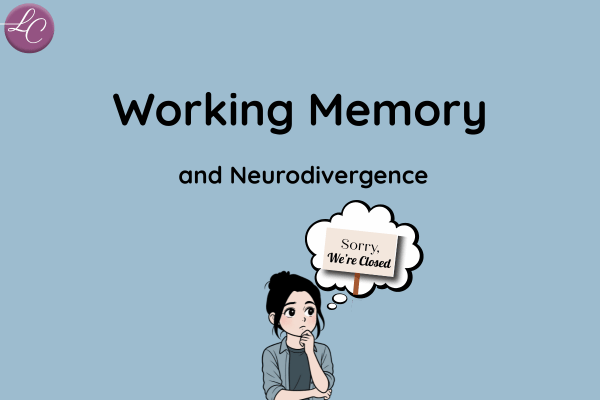
    Working Memory and Neurodivergence

    Working Memory and Neurodivergence

    Working Memory and Neurodivergence

    Why It Feels Hard and Practical Ways to Cope

    Have you ever opened your laptop only to stare blankly at the screen, forgetting why you turned it on?

    Or started speaking and felt the idea vanish, like a soap bubble popping mid-air?

    That’s working memory at play — and for many neurodivergent adults, it’s a daily challenge.

    What Is Working Memory?

    Working memory is the brain’s short-term holding space.

    It’s what keeps information “on hand” just long enough to use it — like remembering a recipe step while you stir the pot.

    But for many autistic and ADHD people, that sticky note is unreliable.

    It’s like trying to write on misted glass — words fade before you finish.

    The Sensory Experience Inside

    Working memory slips aren’t just cognitive — they’re sensory and emotional too.

    • A thought disappears with a pop, leaving silence where words should be.
    • Static buzzes through the mind, drowning out clarity.
    • A forgotten step sparks a rising flutter of panic in the chest.
    • Sometimes it’s like chasing a slippery fish through water — you almost catch it, then it’s gone again.

    These experiences can feel embarrassing, overwhelming, and isolating.

    Strategies That Actually Help

    The good news? We can support ourselves with tools and habits that reduce the load on working memory.

    • Externalise your brain. Use apps, calendars, sticky notes — anything to capture information outside your head.

    • Lean on visual cues. Leave your cup by the kettle, your bag by the door, your notebook on the desk. Objects become memory triggers.

    • Break things down. Focus on one step at a time. A checklist can be grounding and calming.

    • Time in chunks. Short bursts of focused time (like 15–20 minutes) with breaks in between can keep overwhelm at bay.
    • Build supportive routines. Automatic habits reduce the need for remembering. Always putting your keys in the same bowl = less stress.

    Reframing the Narrative

    Working memory difficulties aren’t laziness or lack of care.

    They’re part of how some brains work.

    When we stop blaming ourselves and start creating supports, life flows more smoothly.

    View the Video

    In this video, I share personal experience and insights — and share tips that help me stay on top of things!

    Final Reflection

    If you’ve ever struggled with working memory, know this: you are not broken.

    You’re simply wired differently, and that difference comes with its own rhythms and wisdom.

    🌿 If you’d like to explore ways to make life gentler — through Radiance Coaching, Sound Healing, or building supportive strategies — connect with me here.