Familiar Music, New Ears: How Our Relationship With Songs Changes

Familiar Music, New Ears: How Our Relationship With Songs Changes

Familiar Music, New Ears

How Our Relationship With Songs Changes

Familiar music can become something quite different as we move through life. A song that once felt mysterious, exciting or comforting may eventually reveal meanings, details and emotions we could not have noticed when we first encountered it.

The recording has not changed.

We have.

That difference can make returning to music we have known for years surprisingly revealing.

A familiar song can become a kind of time capsule. It carries something from the person we were, while also giving the person we are now something new to discover.

A Song Can Stay the Same While We Change

Think about a song you have known for decades.

Perhaps you first heard it as a teenager. Maybe it became associated with a friendship, a particular place or a period of your life. You may have listened to it hundreds of times without ever thinking particularly deeply about its lyrics, instrumentation or structure.

Then, one day, something catches your attention.

A line you had barely registered suddenly feels significant.

An instrument you had never consciously noticed becomes impossible to ignore.

The overall atmosphere feels different.

Nothing in the recording has altered. Your perspective has.

We Do Not Hear Everything the First Time

Music contains layers.

Sometimes we respond first to the obvious things: the melody, the voice, the rhythm or the overall feeling.

Other elements may sit quietly underneath, waiting for our attention.

A bass line might have been there all along.

So might a particular guitar texture, harmony or rhythmic pattern.

Our attention changes as we listen.

Furthermore, our experiences give us new reference points through which to understand what we hear.

That means a song can continue to unfold long after we thought we knew it.

Returning Can Reveal Something New

I have songs in my life that have travelled with me for decades.

One of those is Tantalized by The Church. (Yes, they spelled it with a “z”!)

When I first encountered The Church in the 1980s, I was drawn to their individuality and to the atmosphere created by the guitars, bass and vocals. The music seemed to invite imagination rather than provide neat explanations.

Years later, returning to Tantalized brought something else into focus.

The song still created that strange, colourful, almost other-worldly marketplace in my imagination. Yet I also began hearing different ideas within it, including reflections on work, inspiration and the uncomfortable experience of being surrounded by people who tell you what you want to hear.

Most unexpectedly, I became much more aware of the bass.

While everything else seemed to create a world to wander through, the bass provided something steady underneath it all.

A baseline.

An anchor.

Watch the Tantalized episode of The Outsider Within:

Music Can Hold Mystery Without Requiring a Solution

Some music keeps us coming back precisely because it does not explain itself completely.

There is something compelling about a song that leaves gaps for us to fill.

Perhaps we imagine a place.

Perhaps we construct a story.

Maybe we attach our own meaning to a line that could be interpreted in several ways.

Rather than reducing the experience, ambiguity can make it richer.

Our imagination gets somewhere to play.

That can be particularly meaningful for people who experience music intensely or associate sound with vivid internal imagery. A song does not always need to tell us what it means. Sometimes the space around the meaning is part of the attraction.

The Meaning of a Song Can Change

A song may once have represented freedom.

Later, it might remind us of loss.

Another may have felt romantic when we were younger, only to become a song about friendship, belonging or a particular chapter of our lives.

Even the words can acquire new significance as our experiences accumulate.

Perhaps we understand work differently now.

Perhaps relationships have taught us something we could not have known then.

Maybe we have encountered the very patterns a song seemed to hint at, and suddenly its observations land differently.

Our lives become part of the listening experience.

Familiar Music Can Connect Different Versions of Our Story

There is something lovely about being able to hear a song from the past without needing to become the person you were when you first heard it.

You can –

  • Remember that time
  • Recognise what mattered to then
  • Notice what has changed.

At the same time, the song can belong to you now as well.

This is one reason music can be such a powerful part of identity.

It can carry continuity through change.

A song may remind us that we have travelled a long way, while also showing us that some things have remained important.

Try Listening to an Old Favourite With New Ears

Choose a song you have known for years.

Before pressing play, take a moment to notice what you remember about it.

Then listen without doing anything else.

You might notice:

  • An instrument you have never really heard before
  • A line that now feels different
  • A forgotten rhythm or melody suddenly standing out
  • Feelings that have changed over time
  • A memory surfacing unexpectedly
  • Something you once understood differently taking on new meaning

Afterwards, ask yourself: What am I hearing now that I could not hear then?

You might also wonder: What has changed in the song, and what has changed in me?

We Can Return Without Going Back

Returning to familiar music does not mean returning to the past.

Instead, it gives us an opportunity to encounter something from the past with the awareness we have now.

That can make old music surprisingly alive.

A song can remain a companion while its meaning continues to move.

Perhaps that is part of the magic.

We keep listening.

The music remains.

And every now and then, we hear something that has been there all along.

You May Also Be Interested In

Music as a Portal: Where Does Your Favourite Song Take You?

Explore the ways music can transport us through memory, emotion, imagination and inner worlds.

Neurodivergent Identity and Emotional Recognition Through Music

Consider how music can help us recognise and connect with aspects of ourselves that can be difficult to articulate.

Neurodivergent Self-Acceptance in Adulthood

Explore the journey towards understanding and accepting yourself beyond the expectations of others.

Music as a Portal: Where Does Your Favourite Song Take You?

Music as a Portal: Where Does Your Favourite Song Take You?

Music as a Portal: Where Does Your Favourite Song Take You?

Music as a portal can open doorways into memories, emotions, imagination and experiences that are difficult to access in other ways.

A familiar song can transport us somewhere almost instantly. A melody may return us to a particular moment in time, remind us of someone important, create vivid images in our minds or shift the way we experience the present moment.

The music itself has not changed who we are.

Instead, it has created a pathway.

It has invited us into a different experience of ourselves.

Music Can Take Us Somewhere

Some songs feel like journeys.

Within a few seconds, we may find ourselves somewhere else entirely.

Perhaps it is a:

  • Childhood memory
  • Place we once visited
  • Moment we thought we had forgotten
  • Feeling we have not experienced for a while
  • Or an imagined world that exists only within our own mind

Music has a unique ability to connect with parts of our experience that do not always arrive through words or deliberate thought.

Sometimes a song brings back a memory before we have consciously identified what it is connected to.

A rhythm, a melody or a particular sound may unlock a feeling that has been quietly stored away.

Music Can Create Worlds Without Explaining Them

Instrumental music is especially fascinating because it can communicate personality, movement and atmosphere without lyrics.

A piece of music can feel:

  • Playful
  • Mysterious
  • Confident
  • Gentle
  • Curious
  • Powerful
  • Reflective

We often sense these qualities before we analyse why.

The Pink Panther theme by Henry Mancini is a wonderful example of this.

Within the opening notes, many people immediately recognise a particular character. The music suggests movement, personality and attitude without needing to explain anything.

It creates a world.

It invites us to imagine.

Watch the Pink Panther episode of The Outsider Within here:

Music Can Connect Us With Feelings

Music can also act as a pathway into emotion.

Not because a song forces us to feel a certain way, but because it creates space for feelings that may already exist within us.

A piece of music may help us access:

  • Joy that has been buried under busy days
  • Calm during times of overwhelm
  • Confidence when we need encouragement
  • Nostalgia for earlier experiences
  • Curiosity and imagination
  • A sense of freedom or possibility

The same song may offer something different at different points in our lives.

A song that once represented excitement may later become connected with grief, growth or change.

Our relationship with music evolves because we evolve.

Music Does Not Create a Different You

Sometimes we talk about music bringing out a different side of ourselves.

However, I think there is something more nuanced happening.

Music does not create a new version of us.

Instead, it can give certain qualities more room to be experienced.

A song may remind us that we are playful.

A melody may reconnect us with creativity.

Perhaps there’s a rhythm that may help us feel more confident, expressive or alive.

Those qualities were not created by the music.

The music simply opened a doorway.

The Body Often Enters the Conversation

Music is not only something we hear.

It is something we experience.

A song may change:

  • Our posture
  • The way we move
  • Our breathing
  • Our energy
  • The images we imagine
  • The way we connect with a moment

This is why music can feel so powerful.

Our bodies often respond before our minds have explained what is happening.

A particular song might make us sway, dance, walk differently or become still.

Those responses are part of the conversation between sound and self.

Creating Your Own Music Portal Map

If music can open doorways, it is worth exploring where your own favourite songs take you.

A useful reflection is not only:

“What music do I like?”

but also:

“Where does this music take me?”

You might notice songs that:

  • Return you to important memories
  • Help you feel a particular emotion
  • Inspire creativity
  • Make you feel more like yourself
  • Open imaginary worlds

To explore this further, you can download the Your Personal Music Portal Map reflection guide.

Your Personal Music Portal Map


Get Access Now

Where Does Your Music Take You?

There is no single way to experience music.

A song may be a memory, place, feeling, story, a doorway into imagination.

Perhaps the next time a familiar song begins, you might pause and notice:

Where is this music taking me?

When Emotions Aren’t Just Yours: Emotional Overload in Neurodivergent Adults

When Emotions Aren’t Just Yours: Emotional Overload in Neurodivergent Adults

When Emotions Aren’t Just Yours

Emotional Overload in Neurodivergent Adults | OPS, Emotional Absorption, and Nervous System Overload

Sometimes what feels like anger is actually accumulation

There are moments when emotions rise sharply and it feels as though something inside has shifted without warning.

Frustration appears quickly.
Irritation builds faster than expected.
Everything feels “too much” at once.

In these moments, it can be tempting to interpret what is happening as a personal flaw in emotional regulation.

Yet for many neurodivergent people, what shows up as anger is often something else entirely.

A build-up of absorbed experience.

A saturation of emotional input.

And a nervous system that has taken in more than it can currently process.

OPS: Other People’s Stuff

A useful way to understand this experience is through the idea of OPS — Other People’s Stuff.

OPS describes the emotional residue we can unintentionally carry from environments, interactions, and social spaces.

This might include:

  • Tension absorbed from conversations
  • Emotional intensity in shared environments
  • Unspoken stress in a room
  • Micro-adjustments made to match others
  • Long periods of masking or emotional monitoring

Over time, these inputs do not always stay separate from our own internal state.

They can accumulate.

And when they do, the nervous system may begin to feel crowded from the inside.

Emotional absorption is not a failure of boundaries

For many neurodivergent adults, emotional sensitivity is heightened.

This can be a strength in connection and empathy, but it also means emotional environments can be deeply impactful.

Rather than consciously choosing to take on others’ emotions, the nervous system may simply register and hold them.

This is not weakness.

It is responsiveness.

And without space to discharge or reset, that responsiveness can tip into overwhelm.

When overload looks like anger

As OPS builds, the nervous system begins to signal that something needs attention.

That signal can look like:

  • Irritability
  • Restlessness
  • Emotional reactivity
  • Withdrawal
  • Sudden fatigue
  • A sense of internal pressure

On the surface, this may resemble anger.

But underneath, it is often a request for release.

Not everything that feels like anger is anger.

Sometimes it is accumulation finally reaching visibility.

Music as emotional clearing and separation

One of the most powerful tools for many neurodivergent people is music.

Not just as background sound, but as an active regulatory force.

Certain songs can:

  • Discharge emotional buildup
  • Create internal spaciousness
  • Help separate “self” from absorbed energy
  • Restore a sense of identity
  • Shift nervous system state without words

Music can act like a boundary without needing language.

It can move what has become stuck.

In this way, it is not only comfort, but processing.

Returning to self after emotional saturation

When OPS has been present, one of the most important needs is reconnection.

Not correction.

Not suppression.

But return.

This might involve:

  • Gentle sensory regulation
  • Time without input
  • Movement or rest
  • Music that feels clearing rather than stimulating
  • Quiet spaces where no emotional matching is required

In these moments, the goal is not to “fix” emotion.

It is to allow the nervous system to settle back into its own shape.

Emotional awareness without self-blame

Understanding OPS changes the internal story.

Instead of asking: “Why am I like this?”

There is space to ask: “What have I been holding that isn’t mine?”

That shift alone can soften self-judgement significantly.

It allows emotional experience to become information rather than identity.

Listening inward again

When emotional noise clears, something quieter often returns.

Clarity.

Perspective.

A sense of self that was temporarily buried under accumulation.

That return is not dramatic.

It is subtle.

But it is deeply important.

Because beneath emotional overload is often a nervous system simply asking for space to be itself again.

Latest Video – and releasing OPS

Watch it here.

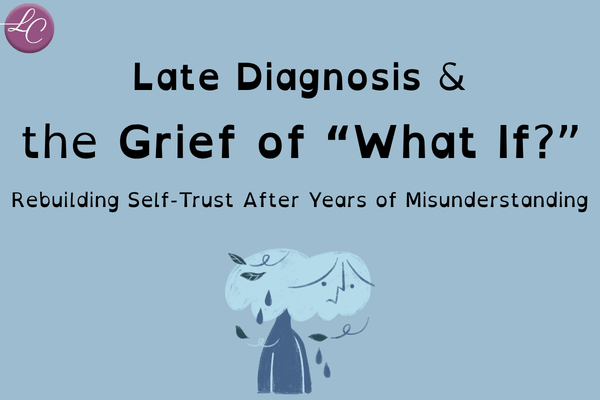
Late Diagnosis and the Grief of “What If?”

Late Diagnosis and the Grief of “What If?”

Late diagnosis neurodivergent adults after years of misunderstanding

For many neurodivergent adults, diagnosis answers questions that may have echoed quietly for years.

Why  –

  • Was everything so hard?
  • Did life seem to require so much more effort?
  • Did the strategies that worked for others so often fall apart?
  • Didn’t “potential” match lived reality?

Receiving answers can feel like finally being handed a missing map.

Relief often arrives first.

Then, for many, grief follows close behind.

Not because diagnosis is tragic, but because understanding can illuminate just how long misunderstanding shaped your life.

Grief does not always look like sadness

Sometimes grief sounds like anger.

You may grieve the support you never received.
Certain memories may suddenly look different through a new lens.
Many people mourn years spent believing they were lazy, inconsistent, broken, or simply failing at adulthood.

Questions often surface:

“What would my life have looked like if I’d known sooner?”
“Who might I have been with support?”
“How much of me was survival?”

This grief is deeply real.

Late diagnosis can involve mourning not only missed accommodations, but also the identity built around self-blame.

Gold stars, masking, and the cost of external worth

Many late-diagnosed adults built their lives around coping mechanisms that looked successful from the outside.

Overachievement.
Perfectionism.
People-pleasing.
Hyper-independence.
Constant productivity.

These patterns can become armour.

For some, achievement becomes proof of worth.
For others, masking becomes so automatic that identity itself can feel blurry.

Without realising it, many spend years chasing external validation while privately wondering why everything feels so exhausting.

Then comes the confronting question:

Who am I without survival mode?

This can feel destabilising.

It can also be the beginning of something profoundly freeing.

Self-trust often needs rebuilding

When your own needs were overlooked, minimised, or misunderstood for years, reconnecting with yourself can take time.

Late diagnosis is not simply about receiving information.

Often, it is about learning to trust your own experience again.

This may mean:

  • Recognising burnout before collapse
  • Identifying sensory needs
  • Creating accommodations without shame
  • Redefining productivity
  • Questioning internalised deficit narratives
  • Allowing capacity to matter

For many neurodivergent adults, this process is less about reinvention and more about reunion.

A return to self.

Accommodation is not failure, it is wisdom

There can be profound tenderness in asking:
“What do I actually need?”

Perhaps you need more recovery time.
Maybe structure helps.
Perhaps flexibility matters more than consistency.
Some may need fewer commitments, gentler transitions, or sensory support.

These choices are not evidence of inadequacy.

They are often acts of self-respect.

Creating a life that honours your nervous system can feel radical after years spent trying to force yourself into unsustainable systems.

Yet this shift is often where healing begins.

“Trying” may not look how the world expects

One of the deepest wounds many neurodivergent adults carry is the fear that invisible effort does not count.

There are days when surviving is trying.
Resting can be trying.
Saying no may be trying.
Choosing not to abandon yourself can be trying.

Effort is not always externally impressive.

Sometimes, the bravest form of trying is refusing to give up when your capacity looks different than it once did.

This matters.

Because self-worth built only on visible output is fragile.

Self-worth rooted in humanity is far more sustainable.

Beyond “What if?” lives “What now?”

Grief deserves space.

So does possibility.

While late diagnosis may never erase the ache of earlier misunderstanding, it can create something else:

Choice.

Choice to –

  • Understand yourself differently
  • Replace shame with context
  • Build accommodations
  • Honour capacity
  • Choice to stop measuring worth solely by output.

You are not meeting yourself too late.

You are meeting yourself now.

And sometimes, that meeting changes everything.

Videos

And my latest YouTube video is a two-part conversation with Chloe Wigan, exploring late diagnosis, invisible effort, self-understanding, and the quiet grief that can come with finally realising life was hard for reasons you may not have understood at the time.

Chloe’s story offers compassionate insight into masking, self-worth, accommodations, and the journey from self-blame to deeper self-trust.

Neurodivergent Self-Acceptance: Moving Beyond “Too Much”

Neurodivergent Self-Acceptance: Moving Beyond “Too Much”

Neurodivergent Self-Acceptance

For many adults who are neurodivergent self-acceptance is not something that was built early.

It is something we learn later.

Often after years of:

  • Masking
  • Adapting
  • Questioning ourselves
  • Trying to fit systems that never quite fit us

The shift into self-acceptance can feel unfamiliar.

And sometimes, uncomfortable.

Where “Too Much” Begins

Many adults carry a quiet internal narrative:

“I am too much.”
“Too sensitive.”
“I’m too intense.”
“Too emotional.”

These beliefs rarely begin in adulthood. (More about this here.)

They are shaped through repeated experiences of mismatch.

Moments where your natural way of being was misunderstood, corrected, or minimised.

Over time, those external messages become internal ones.

Rebuilding Self-Acceptance

Self-acceptance is not about ignoring challenges.

It is about holding a fuller, more accurate picture of yourself.

Practical ways to begin include:

  • Noticing your internal language without judgement
  • Reframing differences as variations, not deficits
  • Identifying environments that increase or reduce overwhelm
  • Allowing preferences without needing to justify them
  • Recognising strengths alongside challenges

This is not a quick shift.

It is a gradual return to yourself.

Boundaries as Self-Respect

One of the clearest expressions of self-acceptance is boundaries.

Not rigid walls.

But informed choices.

You might begin to:

  • Say no without over-explaining
  • Limit environments that drain you
  • Choose depth over obligation in relationships
  • Step back from constant availability
  • Protect your energy as something valuable

Boundaries are not selfish.

They are supportive.

Regulation Before Reflection

Self-acceptance is much harder when your nervous system is overwhelmed.

This is where regulation practices matter.

You might explore:

  • Rhythmic sound to ground the body
  • Quiet sensory spaces to reduce input
  • Gentle movement to discharge energy
  • Breath patterns that extend the exhale
  • Sound or frequency-based practices that support calm

When the body settles, the mind softens.

From there, reflection becomes safer.

Watch the Videos

Part 1

Part 2 – drops on 16 April 2026

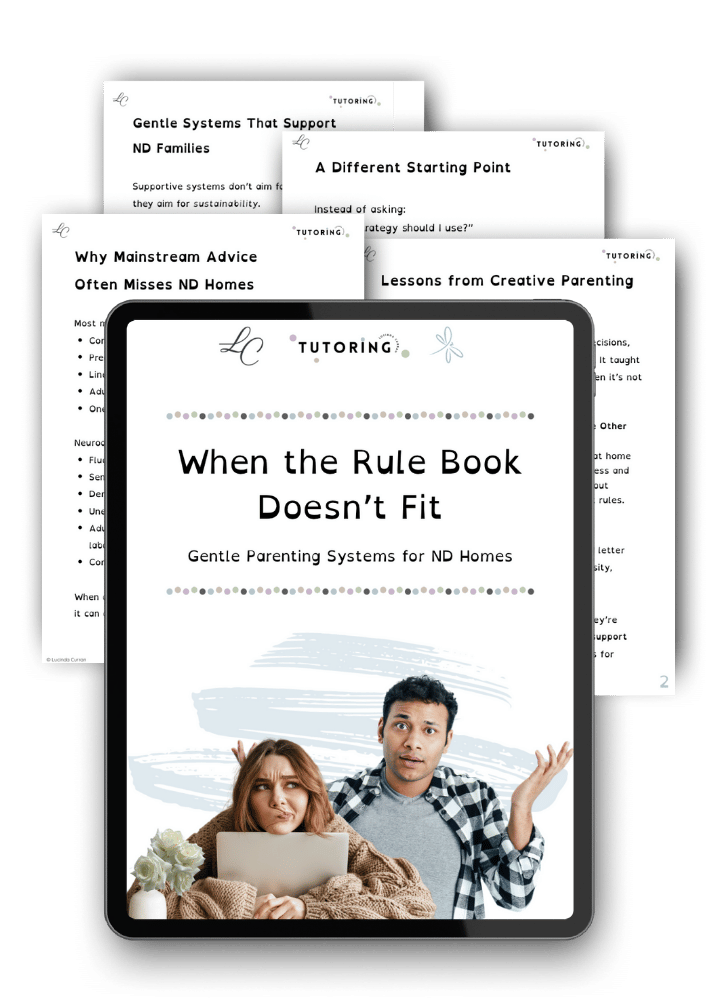
When the Rule Book Doesn’t Fit - Gentle Parenting Systems for ND Homes display

A Broader Invitation

If this resonated, you are not alone.

Many neurodivergent adults reach a point where they realise the systems they’ve been trying to follow were never designed for how they think, feel, or process the world.

Change doesn’t begin with pushing harder.

It begins with understanding yourself differently.

That’s why I created When the Rule Book Doesn’t Fit — a gentle starting point for exploring new, more supportive ways of living and working with your brain.

Get your free copy here

If you find yourself wanting deeper, more embodied support with regulation, energy, and reconnection, you might also explore Radiance Reset.

It’s not about fixing who you are.

It’s about creating space to come back to yourself.

You May Be Interested

If this resonates, you might also explore:

Why The Outsider Within Exists

Why The Outsider Within Exists

Why The Outsider Within Exists

Music and Neurodivergent Identity

The Outsider Within is something I’ve been circling for a long time.

It wasn’t a sudden idea. It was more like a quiet thread running through my life, becoming clearer as I began to understand myself more fully.

Receiving my AuDHD diagnosis just under a year ago didn’t change who I am — but it did bring clarity. It gave language to patterns I had always felt but couldn’t quite name.

And one of the clearest patterns was this:

Music has always been regulation

For me, music has never been background noise.

It has been something I reach for instinctively — not just to enjoy, but to regulate.

  • Some songs help me settle when my system is overwhelmed
  • At other times, music helps me focus when my thoughts scatter
  • There are tracks that hold me when things feel too much
  • Others bring me back when I feel flat or disconnected
  • And some restore energy in a way nothing else can

Music meets me where I am.

Not all regulation is calm

There’s a common assumption that regulation always looks like slowing down.

But that’s only part of the picture.

Sometimes, regulation comes through activation.

  • Fast rhythms
  • Strong bass
  • Emotional intensity
  • Movement and momentum

For many neurodivergent people, high-energy music can bring the nervous system back online.

It doesn’t soothe.

It ignites.

One of the clearest examples of this for me is She’s Kerosene by The Interrupters — a song that restores energy, focus, and a sense of aliveness when I need it most.

The quiet layer of shame

The music that supported me the most wasn’t always understood.

It didn’t always fit what was considered “appropriate” or “normal”.

And over time, I noticed something sitting quietly underneath that.

  • A hesitation to share
  • The tendency to filter
  • A sense of needing to keep parts of myself hidden

A subtle layer of shame.

Letting that go

The Outsider Within exists because I’m no longer willing to carry that.

It’s a space where I can share openly:

  • The music that supports me
  • How it impacts my nervous system
  • What it feels like from the inside
  • The lived experience of being neurodivergent

And it’s a space where others can do the same.

What The Outsider Within is

The Outsider Within is a YouTube playlist and ongoing series exploring music, regulation, and neurodivergent identity.

Within this space, I share:

  • Song-based reflections grounded in lived experience
  • The connection between music and nervous system states
  • The role of sound in regulation, energy, and focus
  • Conversations with guests about the music that supports them

It’s not about analysing music from the outside.

It’s about experiencing it from within.

You’re not the only one

If you’ve ever felt like your inner world doesn’t match what’s expected…

If music has been something you rely on, not just something you enjoy…

Perhaps you’ve quietly loved something you didn’t feel you could share…

You’re not alone.

And you’re not “too much” or “too different”.

You may simply be wired in a way that responds deeply to sound.

Start here

Start with the first video in The Outsider Within series:
This Song Regulates My AuDHD Brain | She’s Kerosene – The Interrupters

Or explore the full playlist (new content released on alternate weeks).

Continue exploring

If you’re interested in how regulation can look different across states, you may also find this helpful: