
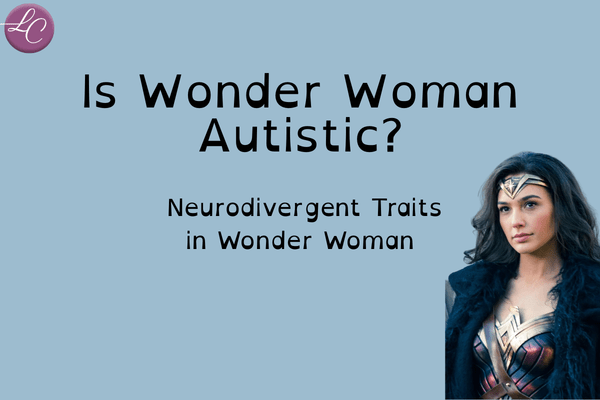
Is Wonder Woman Autistic?
Neurodivergent Traits in Wonder Woman
Some fictional characters stay with us long after the credits roll.
Not just because they are powerful or heroic, but because something about them feels strangely familiar.
For many neurodivergent viewers, Diana in the 2017 Wonder Woman film carries that feeling.
Her –
- Perspective
- Intensity
- Unwavering moral clarity.
None of these traits are labelled in the story.
Yet many autistic and neurodivergent adults recognise something of themselves in the way she moves through the world.
This raises an interesting question.
Not as a diagnosis, but as a lens.
Could Wonder Woman be read as autistic-coded?
Watch the Video
What Does “Autistic-Coded” Mean?
When people describe a character as autistic-coded, they are not claiming the character is clinically autistic.
Instead, they are noticing patterns of behaviour, thinking, or emotional response that closely resemble autistic traits.
Sometimes writers create these traits intentionally.
Other times they emerge naturally when a character is written as an outsider, a truth-teller, or someone who sees systems differently.
Over time, audiences begin to recognise the resonance.
For many autistic viewers, this recognition can feel powerful.
Not because the character is identical to them.
But because parts of their experience are finally visible.
The Power of the Outsider Perspective
One of the most striking things about Diana is that she enters human society as an observer.
Diana was not raised inside its social expectations.
She has not absorbed its compromises.
And has not learned which truths people prefer to ignore.
As a result, she constantly asks questions that others have stopped asking.
❓ Why tolerate injustice?
❔ Why follow rules that cause harm?
⁉️ Why accept systems that perpetuate suffering?
Many autistic adults describe a similar lifelong experience.
Watching social systems from the outside and noticing patterns that others seem strangely comfortable with.
The outsider perspective can feel isolating.
But it can also reveal truths that insiders overlook.
Moral Clarity and the Refusal to Normalise Harm
Diana’s moral clarity is one of her defining traits.
She does not easily drift into the grey areas that others accept.
When she sees suffering, she does not rationalise it.
She does not look away when she sees injustice.
Some people interpret this kind of thinking as rigidity.
But many autistic adults experience it differently.
Not as inflexibility.
But as integrity.
A strong internal sense of right and wrong that does not easily adjust itself simply because social norms demand it.
Intensity, Focus, and Purpose
Another quality that stands out in Diana is the depth of her commitment once she believes she understands the problem.
Her focus narrows.
She pursues the goal with remarkable persistence.
In storytelling, this reads as heroic determination.
But for many autistic viewers, it also echoes something familiar.
The ability to concentrate deeply on a meaningful objective.
The feeling of purpose that can arise when a problem feels both urgent and solvable.
In everyday life, that intensity can sometimes be misunderstood.
In stories, it becomes a superpower.
Empathy That Moves Toward Action
A persistent myth about autism is that autistic people lack empathy.
Yet many autistic individuals describe something quite different.
Their empathy can be intense, immediate, and physically felt.
Diana reflects this beautifully.
When she encounters suffering, she does not remain distant from it.
She moves toward it, protects those who are vulnerable, and intervenes when systems fail.
Her empathy is not abstract.
It is active.
The Symbolism of No Man’s Land
The scene where Diana crosses No Man’s Land is one of the most powerful moments in the film.
Everyone around her insists the battlefield cannot be crossed.
It is too dangerous.
Too exposed.
Impossible/impassable.
But Diana questions the premise.
And when she realises that the accepted limit is simply a rule others have learned to obey, she moves forward.
For many neurodivergent viewers, this moment carries a deeper symbolic meaning.
The realisation that the systems we tried to fit ourselves into were never designed with us in mind.
And that sometimes the most powerful step is to stop waiting for permission.
Why Characters Like This Matter
Representation does not always arrive through explicit labels.
Sometimes it appears through resonance.
A character who –
- Questions the rules
- Who feels deeply
- And who refuses to abandon their sense of justice.
When those traits are framed as strengths rather than problems, something shifts for the viewer.
Difference begins to look less like a flaw.
And more like a form of power.
A Reflection for You
Sometimes the characters who stay with us are the ones in which we recognise something in them (and us) and before we have words for it.
You might like to pause for a moment and reflect:
- Which fictional characters have always resonated with you?
- What traits or behaviours made them feel familiar?
- Were they outsiders, truth-seekers, protectors, or system-questioners?
- Did they show strengths that others misunderstood?
Stories can help us see ourselves from a new perspective.
And sometimes the characters we admire most are quietly reflecting qualities we already carry.
For many neurodivergent adults, there comes a moment of recognition.
You begin to notice that your mind works differently.
Your nervous system responds differently.
And the expectations you were given were never designed with you in mind.
If this reflection resonates, I created something inspired by that moment — When the Rule Book Doesn’t Fit.
It’s for neurodivergent adults and reflective parents who are ready to question inherited templates and begin building regulation-informed ways of living that actually honour how their brains and bodies function.