Creative Parenting for Neurodivergent Children – Part 2
Creative Parenting for Neurodivergent Children
The Nurturing Practices That Shape a Life
When people talk about parenting, they often focus on outcomes.
Resilience.
Independence.
Confidence.
What rarely gets talked about is the felt sense a child carries into adulthood — the quiet, embodied knowing of whether they were safe to exist as themselves.
When I reflect on creative parenting for neurodivergent children, I don’t first think about strategies.
I think about atmosphere.
The nurturing practices my Mum offered weren’t grand or performative. They lived in the ordinary spaces: bedtime, play, food, conversation. And yet, they shaped everything.
Because what she gave us was not performance.
It was safety.
Stories as Regulation
Some nights, Mum read to us.
Some nights, she couldn’t.
She was a single parent, exhausted long before exhaustion had language. But even when she didn’t have the energy to read, she lay beside us and told stories instead. Familiar ones. Tweaked ones. Magical ones that felt half-alive in the dark.
Looking back as a neurodivergent adult, I see what those stories really were.
They were regulation.
Softening the edges of the day.
Creating continuity.
Offering predictability wrapped in imagination.
For neurodivergent children, stories can act as a bridge — between stimulation and rest, between chaos and coherence.
When I think about creative parenting for neurodivergent children, I think about that bridge.
Play as a World-Building Tool
We grew up with very little money, but we never felt deprived.
A cardboard box became a stagecoach.
A footstool became a driver’s seat.
Hobby horses carried us into entire worlds.
What mattered wasn’t the object. It was the permission.
Permission to —
- Imagine fully
- Immerse
- Take play seriously.
As an adult, I understand something I couldn’t name then:
Imagination is not escapism for neurodivergent children.
Imagination is processing.
Integration.
It is nervous system recalibration through story and movement.
Creative parenting for neurodivergent children honours this instead of dismissing it.
Meeting Sensory Needs with Creativity
Food was complicated.
Textures lingered.
Smells overwhelmed.
Certain after-feels stayed far too long.
Instead of forcing compliance, Mum invited curiosity.
Enter: Spiderman’s favourite foods.
One day a letter arrived. A list was revealed. Suddenly, the question shifted from
“Why won’t you eat this?”
to
“What would Spiderman choose?”
Play replaced pressure.
Identity replaced shame.
When a neurodivergent child feels respected instead of corrected, the nervous system loosens its grip.
That shift is not small.
It is foundational.
Trust as the Ultimate Gift
As we grew older, Mum didn’t tighten control.
She loosened it.
Decisions were talked through. Risks were named. But the final choice was ours. And when things didn’t work out, she didn’t weaponise hindsight.
She stayed.
As a neurodivergent adult reflecting back, this might be the practice that shaped me most.
Trust teaches responsibility without fear.
Autonomy without abandonment.
Exploration without exile.
Creative parenting for neurodivergent children is not about removing structure.
It is about embedding structure inside relationship.
Video: Creative Parenting for Neurodivergent Children – Part 2
In Part 2 of this series, I explore these themes more deeply — and what happens when traditional parenting frameworks simply do not fit the nervous system of the child in front of you.
A Closing Reflection
What stays with me is not any single strategy.
It is the orientation underneath it all.
We were —
- Seen
- Trusted
- Allowed to become.
As an adult, that early sense of safety still lives in my nervous system.
Creative parenting for neurodivergent children does not guarantee ease.
But it does shape identity.
It shapes whether a child grows up believing they are a problem to be solved —
or a person to be understood.
That difference lasts a lifetime.
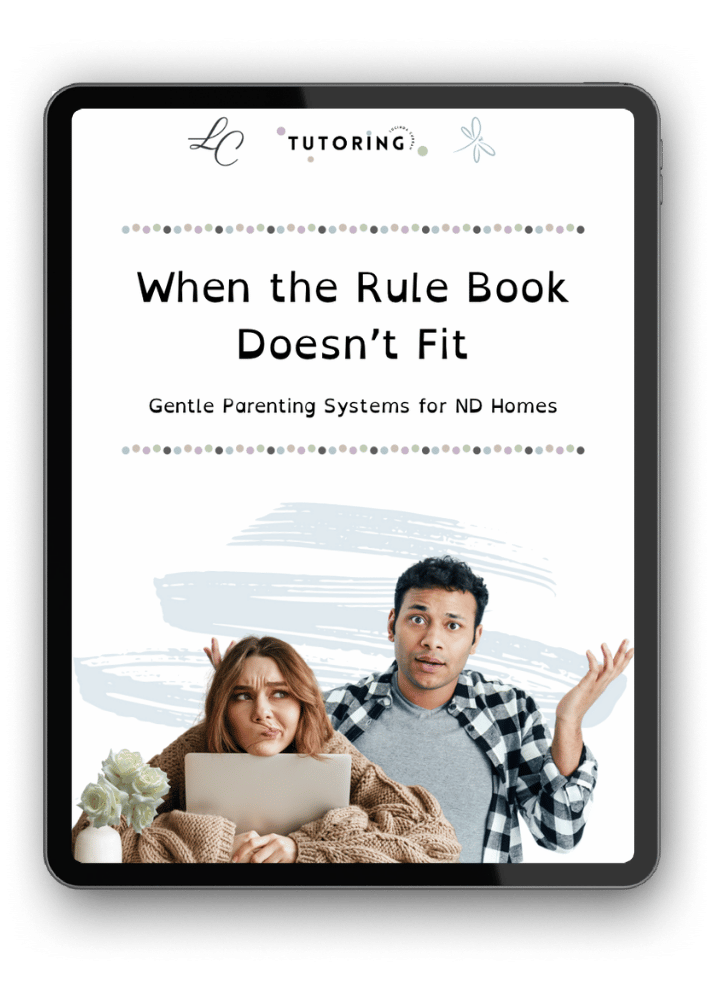
When the Rule Book Doesn’t Fit
For many neurodivergent adults, there comes a moment of reckoning:
You realise the rule book you were handed was never written with you in mind.
If this reflection resonates, I’ve created something inspired by this very truth – When the Rule Book Doesn’t Fit
It’s for neurodivergent adults and reflective parents who are ready to question inherited templates and create regulation-informed ways of living instead.
You Might Also Be Interested In
Creative Parenting for Neurospicy Kids: The Clever Systems My Mum Used (Part 1)
A reflection on the gentle systems that quietly reduced conflict and built safety.
Creative Parenting for Neurodivergent Learners: When the Rule Book Doesn’t Fit (Part 2)
A learning-focused perspective on regulation before compliance.
Daydreaming or in Shutdown? How to Support Neurodivergent Kids (and Yourself)
Pick the differences between daydreaming and shut down – it matters!